Community building is something I never thought was my expertise.
Sure, I was one of the first employees of a nonprofit that built the early renewable energy coalitions in the early 2000s. We “built the table” for the policy and finance conversations that in turn built that industry. But from my vantage point in Washington DC at the time that seemed so far removed from where people lived, played, worked. At the time it seemed unsatisfying in the way we would say now a zoom conference is (not) the real thing.
At the time, as a recent grad choosing to work in climate, it seemed I had two choices:
- Address the issues at the national or state level with large scale programs and policies (and that network is the “community” to serve)
- Go all in in your local community and help reduce transportation, food waste, recycle, and the like.
I realize this sounds like a ridiculous and false choice. That is the point. But this is how things were at the time for me. There was the sense of choosing change from the inside government and corporations without impacting my own community, or change in your community without large scale impact.
Getting my MBA and hearing the voices from environmental leaders saying “we need creative ways to fund and scale our impact” was a pivot point for me. I heard Joe Whitworth speak at my impact investing course and describe how as a nonprofit leader he was in the cycle of fundraise – do – fundraise – do and doing great things but wanted to find a way to make exponential impact. If corporations can experience exponential growth, why cant our efforts to stop climate change? So he found another way. He found ways to influence policy to build a credit trading market, changing the rules and building the ecosystem for exponential investment in the reforestation work he had been doing.
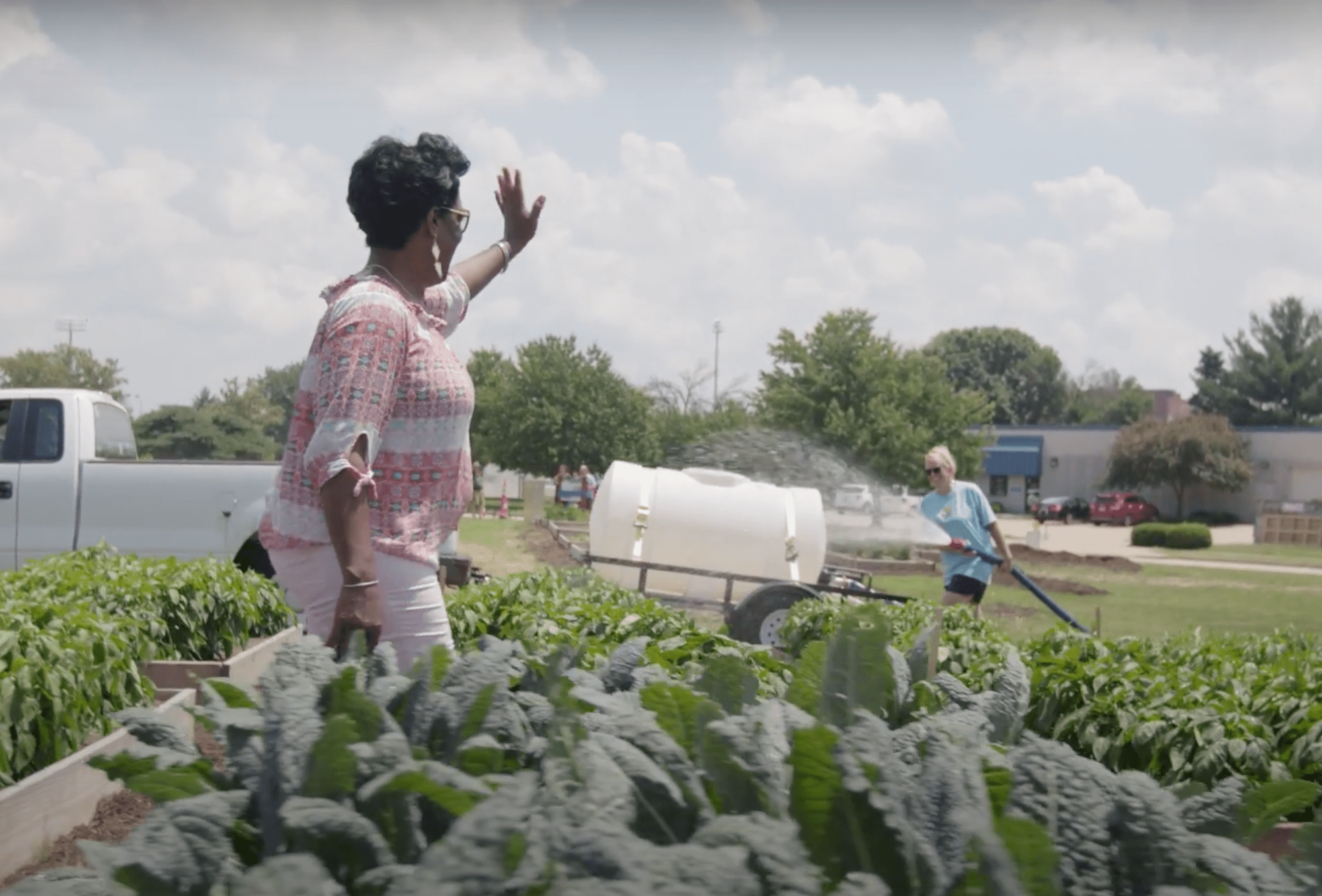
But it wasn’t until I founded Greenprint Partners with my co-founders from that same impact investing course that I was able to bring together true community development with my environmental and climate change efforts. At Greenprint, one of the landmark projects I led was the Well Farm at Voris Field in Peoria Illinois. How did we come up with that fancy name? We asked the community what they thought. Why did we plant the raised bed gardens that we did with the fresh veggies that we did? We asked the community what they thought. I don’t take credit for the artful facilitation and organizing of my colleagues. But I had the pleasure to design and launch the program that centered on a key central hypothesis: climate resilient infrastructure can be designed with deep community engagement, resulting in ongoing community investment. We had an urban agriculture apprenticeship program, a neighborhood stakeholder group, and all the features of a site that can manage stormwater from overflowing with raw sewage during increasingly large storm events in the city.
After the Well Farm, we repeated this basic model again. And again. Dozens of times more and counting. Community benefits-driven design became a part of our brand. I built the system that tracked our diversity and community inclusion commitment in our ESG reporting. I saw our efforts trend over time as we grew. It still was not part of my own professional identity with so many other things going on.
It was only after this past year of reflection that I realized how, for the first time, my strong personal value of community and supporting the place where I live had been so fulfilled in my work and yet so much of that work was focused nationally. I need to focus both nationally and in my own community in San Diego. I realized too, that the cleantech industry of which I am still a part still has so so much work to do on the topic of community engagement and what it means to support diversity, equity, inclusion, and justice. And of course the whole nation is still reckoning with what it means to uncover our biases and serve our whole communities, inclusively and equitably in the wake of George Floyd’s killing and the BLM movement.
And so I have focused on community with a sense of renewed purpose.
 Laura Brenner Kimes
One thought on “Building Community”